
Valencia · 10 min read
Driving and Parking in Valencia: City Centre, Zones & Tips
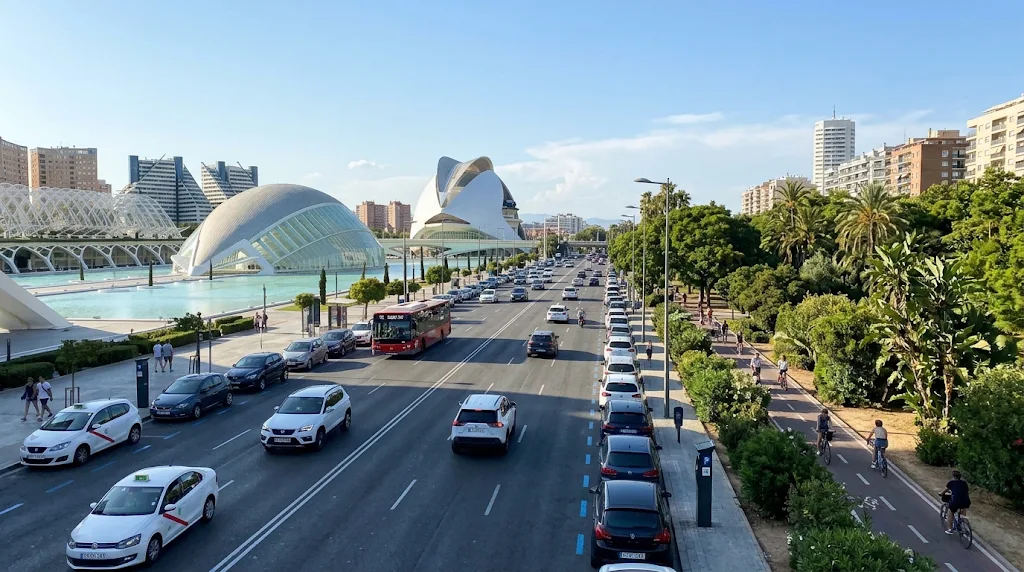
Valencia — Spain’s third-largest city, capital of the Valencian Community, and the birthplace of authentic paella — is one of the most driver-friendly major cities in Europe. It features wide modern avenues, a well-planned system of toll-free ring roads, a flat urban layout, and direct exits heading toward Mediterranean beaches, the Albufera lagoon, and medieval inland villages. Its historic centre (Ciutat Vella), however, is a completely different story: narrow medieval alleys, extensive pedestrian areas, residential priority zones monitored by cameras, and strictly limited street parking.
In this comprehensive guide, we explain when having a car actually makes sense inside and outside the city, how the orbital road network works, where to park stress-free, what to expect from the blue and orange on-street parking zones (ORA), and what you need to know about the Low Emission Zone (ZBE). If you are planning your trip, start by comparing prices and terms for car hire in Valencia across trusted rental suppliers in a single search.
Do You Need a Car in Valencia City?
Before setting off, it helps to distinguish getting around the historic core from taking trips across the wider region. For the old town (Ciutat Vella), the bohemian neighbourhood of Ruzafa, and the Turia Gardens (Jardín del Turia) — the old riverbed converted into a lush 9-kilometre urban park — the short answer is no: you can easily walk everywhere, hop on the modern metro and tram network (Metrovalencia), or hire a bicycle to make the most of the city’s 160+ kilometres of dedicated cycle paths.
In contrast, a car becomes genuinely practical and indispensable when:
- You stay outside the centre or close to the coast: If your accommodation is in beachfront areas like Patacona (to the north), El Saler (to the south), or suburbs near Manises Airport.
- You want to explore the wider Valencia region: The Albufera freshwater lagoon and the village of El Palmar, the Roman theatre and castle of Sagunto, the hilltop fortress of Xàtiva, the seaside town of Cullera, or the hanging suspension bridges of Chulilla. For detailed itineraries, explore our guide to day trips from Valencia by car.
- You travel with family and lots of luggage: Or if you are combining Valencia with an extended coastal road trip along the Costa Blanca — see our route guide for a Costa Blanca road trip: from Alicante to Valencia.
A practical approach that works wonders: Many travellers spend their first 1–2 days sightseeing in the historic core on foot, by metro, and by bike, and pick up their rental car from Joaquín Sorolla central railway station or downtown on the day they head out on excursions. This saves significantly on both car rental days and underground garage fees.
Main Ring Roads and Radial Motorways Around the City
Valencia is surrounded by an efficient network of orbital routes (Rondas) and radial dual carriageways (Autovías). These are completely toll-free and make entering or exiting the city straightforward:
- V-30 (New Turia Riverbed Ring Road): Runs along the new channel of the Turia River south and west of the city, connecting the commercial and passenger ferry port directly with exits toward the Airport, Madrid (A-3), and Alicante (A-7).
- A-7 (Valencia By-pass): The outer motorway bypassing the entire metropolitan area from the west, linking Barcelona/Castellón in the north to the interior and Alicante in the south.
- V-21 (Northern Exit): The fast coastal motorway heading north, ideal for beaches like Patacona and Port Saplaya (“Little Venice”), as well as toward Sagunto.
- V-31 (Pista de Silla – Southern Exit): The main southern arterial road leading to Silla, the Albufera nature reserve, and the AP-7 motorway toward Gandía, Dénia, Benidorm, and Alicante.
- A-3 / V-11 (Western Exit): The motorway linking the city centre with Valencia Airport (Manises – VLC) in around 15–20 minutes before continuing inland toward Madrid.
- CV-500 (Albufera Coastal Route): The scenic route along the narrow spit of land between the sea and the Albufera lagoon, leading to El Saler beach, La Dehesa, and the village of El Palmar.
Rush hour tip: During weekday peak hours (roughly 08:00 – 09:30 and 18:00 – 20:00), incoming and outgoing routes (especially the V-30, V-31, and Avenida del Cid) experience heavier traffic. When planning a day trip, try leaving before 08:00 or after 10:00.
The Historic Centre (Ciutat Vella): Access Restrictions, Cameras & Pedestrian Zones
Large sections of the old town (Ciutat Vella) — especially around El Carmen, La Seu, El Mercat, Plaza de la Reina, Plaza de la Virgen, and the Mercado Central — are pedestrianised or designated as a Residential Priority Area (APR Ciutat Vella Nord). In these streets, the speed limit drops to 20 km/h and all entry points are monitored 24/7 by automatic number plate recognition (ANPR) cameras.
GPS apps (Google Maps / Waze) do not always account for residential access rules and may direct you straight through a restricted entry gate. The golden rule is simple: do not drive into the narrow alleys of the historic centre. Instead, leave your car in an underground car park on the outer perimeter of Ciutat Vella and continue on foot. If your hotel is located within an APR zone, contact them before arriving so they can register your rental car registration plate with municipal traffic authorities.
Low Emission Zone (ZBE – Zona de Bajas Emisiones)
Like other major Spanish cities (Madrid, Barcelona, Seville, Málaga), Valencia enforces a Low Emission Zone (Zona de Bajas Emisiones) covering the urban perimeter inside the ring roads (Rondas). Access is regulated according to the official DGT environmental sticker (Distintivo Ambiental: CERO, ECO, C, or B) displayed on the windscreen.
What this means for car hire: The good news for travellers is that rental fleets in Spain consist almost entirely of modern, near-new vehicles (0–2 years old) with low emissions (rated C, ECO, or CERO). These meet all ZBE standards and can drive freely along Valencia’s avenues. At the rental desk, check that the vehicle displays the DGT badge and confirm there are no local restrictions on your planned route.
Where to Park in Valencia: Zones, Rates & Underground Garages
1. Blue, Orange, Green, and White Zones (ORA Parking System)
In central neighbourhoods (such as Eixample, Ruzafa, Extramurs, and El Pla del Real), street parking is regulated by the municipal ORA system. Always check the road markings and the nearby parking sign:
| Zone Colour | Permitted Users | Cost & Max Time Limit | Operating Hours |
|---|---|---|---|
| Blue Zone (Zona Azul) | All drivers and visitors | ~€0.80 – €1.10 / hour — Maximum stay: 2 hours | Monday – Saturday: 09:00 – 14:00 & 16:00 – 20:00 |
| Orange Zone (Zona Naranja) | Mixed zone prioritising residents (visitors allowed during paid hours only) | ~€1.50 – €2.00 / hour — Maximum stay: 1–2 hours (No visitor parking 20:00–09:00 & Sundays) | Weekdays: 09:00 – 20:00 (Nights & Sundays: residents only) |
| Green Zone (Zona Verde) | Exclusively permanent residents (Residentes) | Strictly prohibited for visitors (Risk of towing) | 24/7 |
| White Zone (Zona Blanca) | All drivers (Free on-street parking) | €0 (Free) with no time limit | 24/7 |
Important detail: In the Blue Zone, parking is free during the midday siesta (14:00–16:00), every evening after 20:00 until 09:00 the next morning, as well as all day on Sundays and public holidays. During paid hours, download the Telpark or ElParking app to pay via your smartphone (entering your rental car plate number), extend your time, or stop the parking meter remotely.
2. Underground Car Parks Along the Ciutat Vella Perimeter
For visiting the historic quarter without checking the clock, underground public parking garages ringing the old town are the most stress-free choice:
- Estación del Norte / Calle Xàtiva & Calle Colón area: Large underground garages along the southern edge of Ciutat Vella, outside camera-controlled zones, located just a 5-minute walk from Plaza del Ayuntamiento and Mercado Central.
- Torres de Serranos / Paseo de la Petxina area: Located on the northern and western boundary of the old town along Turia Gardens, offering direct access into the El Carmen neighbourhood.
- Costs & Discounts: Standard rates range between €2.20 – €3.20 per hour, while full-day parking (24 hours) typically costs €18 – €25 (parking apps like Parclick offer discounted multi-day passes online, and several hotels partner with nearby garages).
3. City of Arts and Sciences & Urban Beaches
Near the City of Arts and Sciences (Ciudad de las Artes y las Ciencias), you can use the underground Parking Umbracle or the parking facilities at the El Saler and Aqua Multiespacio shopping centres (which often offer 2–3 hours of free parking). Along Malvarrosa and Las Arenas beaches (Paseo Marítimo / Calle de Eugenia Viñes), you will find hundreds of free white-lined bays along the streets, though these fill up quickly before midday on summer weekends. For beaches further south, see our guide to the best beaches near Valencia by car.
Driving Mistakes in Valencia That Can Cost You Dearly
- Dedicated bus and taxi lanes (Carril BUS-TAXI): Monitored constantly by fixed cameras. Do not enter them to overtake or to make an early right turn before the broken line.
- 30 km/h city speed limits: On all urban streets with a single lane in each direction, a strict 30 km/h limit applies (50 km/h on multi-lane avenues). Speed cameras automatically ticket offenders.
- Cyclists and e-scooters (VMP): Valencia has an exceptionally high volume of cyclists. Always check your wing mirrors and blind spots before turning, as cycle tracks often run parallel right beside traffic lanes.
- Parking on yellow lines or loading bays (Carga y Descarga): The municipal tow truck service (Grúa Municipal) removes illegally parked vehicles within minutes. Towing charges start above €150 on top of the traffic fine.
Remember that traffic fines are forwarded to the rental supplier, which charges an administrative handling fee (roughly €35–€50) in addition to the fine itself. To review general regulations, check our guides on rules and documents for hiring a car in Valencia and driving in Spain: speed limits, tolls, and required documents.
Which Car to Choose & A Practical Itinerary
For driving around Valencia and taking day trips nearby, an economy or compact hatchback (such as a Seat Ibiza, Opel Corsa, Renault Clio, or VW Polo) is the optimal choice: easy to manoeuvre on multi-lane avenues, quick to park in tight blue-zone spots, and comfortable on the steep spiral ramps of underground parking garages. Because manual transmissions represent the majority of rental fleets in Spain, book 3–4 weeks in advance if you prefer an automatic gearbox.
The ideal 4-day to 5-day itinerary: Spend the first two days touring the historic quarter, the City of Arts and Sciences, and Malvarrosa beach on foot, by metro, and by bicycle. On the third morning, pick up your rental car from central Valencia or Joaquín Sorolla station to explore the Albufera lagoon, El Saler beaches, Sagunto, Xàtiva, or Chulilla, before dropping the car off at Valencia Airport for your flight home.
Frequently Asked Questions About Driving and Parking in Valencia
Is driving in Valencia difficult?
Not particularly. Avenues are wide, the city is flat, and direction signage is clear. The main challenge is navigating the narrow pedestrianised lanes of the old town (Ciutat Vella), which you should simply avoid entering by car.
Where should I park to visit Valencia’s historic centre?
Use a public underground car park located around the Ciutat Vella perimeter (for example, near Calle Xàtiva, Estación del Norte, Plaza de la Reina, or Mercado Central). From there, top historic landmarks are just a 3- to 8-minute walk away.
Can a rental car enter the Low Emission Zone (ZBE)?
Yes. Rental vehicles in Spain are modern models carrying eligible DGT environmental stickers (C, ECO, or CERO). Verify the badge upon collecting your vehicle and make sure you do not drive past the residential camera access gates (APR) in northern Ciutat Vella.
Do I need a rental car if I only stay in central Valencia?
For a short 2-day city break spent solely downtown, no. However, if your plans include the beaches of El Saler, Albufera nature park, Sagunto, Xàtiva, or the Costa Blanca coast, renting a car offers unmatched flexibility and saves substantial travel time.
Ready to plan your trip along the Spanish Mediterranean? Compare deals for car hire in Valencia with pick-up at the airport, train stations (Joaquín Sorolla / Estación del Nord), or city centre, and review transparent pricing, rental car deposits, and excess options before you book.
NEXT STEP
Car rental prices in Valencia
More guides · Valencia