
Alicante · 6 min read
Driving in Spain: Speed Limits, Tolls & Required Documents
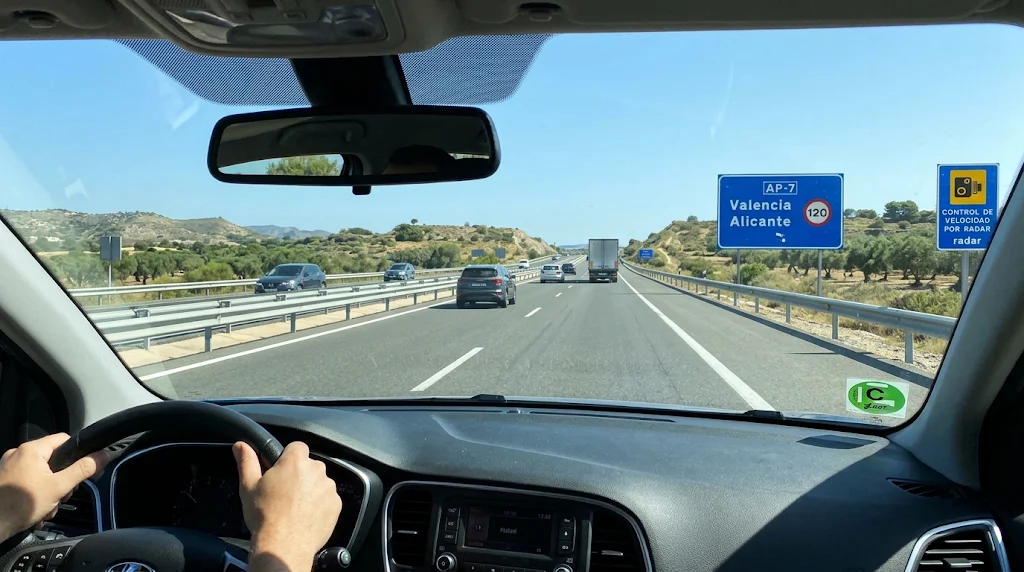
Spain boasts one of Europe’s most extensive, modern, and well-maintained road networks. Whether you are touching down in Madrid to discover Castile, arriving in Málaga for an Andalusian road trip, or landing in Alicante and the Costa Blanca, hiring a car unlocks authentic villages, secluded beaches, and historic landmarks that public transport simply cannot reach.
While general road regulations adhere to European conventions (driving on the right-hand side of the road), Spanish traffic law enforced by the Directorate-General for Traffic (DGT – Dirección General de Tráfico) includes specific rules—such as urban speed limits, Low Emission Zones (ZBE), roundabout priority, and speed cameras—that every driver must know. In this complete guide, we have gathered everything you need to drive safely and avoid traffic fines in Spain.
Required Documents & Mandatory In-Car Safety Equipment
Before collecting your rental car at any Spanish airport or city branch, make sure you carry the following documents in physical form (photos or digital copies on your phone are not accepted by the Spanish traffic police – Guardia Civil de Tráfico):
- Valid Driving Licence: For Greek citizens and EU/EEA licence holders, a valid national driving licence (held for at least 1 year) is fully accepted—no International Driving Permit (IDP) is required. If your licence was issued outside the EU and does not use the Latin alphabet, an International Driving Permit is mandatory alongside your original licence.
- National ID Card or Passport: Valid, for driver identification.
- Rental Agreement: Keep the printed agreement supplied by the car hire company in the glove compartment throughout your journey.
- Mandatory Safety Equipment (check the boot before setting off): Under Spanish law, every vehicle must carry a reflective safety vest (which must be put on before exiting the car during a breakdown) and a V-16 emergency warning light beacon (or warning triangles).
Speed Limits in Spain (DGT) & Speed Cameras
Spain enforces strict speed limits—especially in urban areas, where a default 30 km/h limit applies to most city streets—supported by an extensive network of fixed and mobile speed traps (radares fijos and average speed cameras, radares de tramo):
| Road Type | Speed Limit (Passenger Cars) | Important Details |
|---|---|---|
| Motorways (Autopistas AP & Autovías A) | 120 km/h | The former +20 km/h margin for overtaking on rural roads has been eliminated. |
| Conventional Rural Roads (Carreteras Convencionales) | 90 km/h | May be reduced to 70 or 80 km/h on sharp bends or near intersections. |
| Urban Areas — Roads with 2+ lanes per direction | 50 km/h | Main city avenues (e.g. Madrid, Valencia, Málaga). |
| Urban Areas — Single-lane roads per direction | 30 km/h | The standard baseline across residential and downtown streets in Spain. |
| Urban Areas — Single-level shared streets (pavement & carriageway) | 20 km/h | Historic centres and traffic-calmed residential areas. |
Helpful tip: Fixed speed cameras in Spain are always signposted several hundred metres in advance with distinctive yellow and blue signs. If a speeding violation is recorded in a rental vehicle, the supplier applies an administration fee (~€30–€50) and forwards your details to the DGT, who will mail the notice to your home address (a 50% discount applies if settled within 20 days).
Autopista vs Autovía: How Do Tolls Work in Spain?
Spain has two primary classes of high-speed motorways, easily distinguished by their road signs:
- Autovía (Signposted “A-“, e.g. A-7, A-70, A-4, A-92): State-owned dual carriageways that are 100% free of charge (no tolls) across the entire country.
- Autopista (Signposted “AP-“, e.g. AP-7, AP-6, AP-9): Historically operated as toll roads (Peaje). However, over recent years the Spanish government has removed tolls across extensive stretches of the AP-7—including the entire Costa Blanca route from Alicante to Valencia and up to Catalonia, as well as parts of Andalusia (Seville – Cádiz).
Where do toll roads still exist? Certain motorways still require payment, including the Costa del Sol (AP-7 between Málaga, Marbella, and Estepona), the radial routes around Madrid (R-2, R-3, R-4, R-5), the AP-6 northwest of Madrid (towards Segovia / Ávila), and the AP-9 in Galicia. At toll plazas, steer clear of the “VIA-T” lanes (reserved strictly for electronic transponders) and head for lanes displaying card or cash symbols to pay seamlessly with a contactless bank card.
Low Emission Zones (ZBE – Zona de Bajas Emisiones)
All Spanish cities with a population exceeding 50,000 residents (such as Madrid, Barcelona, Valencia, Seville, Málaga, and Alicante) operate Low Emission Zones (ZBE) in their city centres, where automated cameras read number plates:
- What this means for rental cars: Spanish car hire fleets consist almost exclusively of brand-new vehicles (0–2 years old) carrying the official DGT emissions sticker (C, ECO, or CERO) on the windscreen, granting regular access to most zones.
- Watch out for “Residents Only” zones (Residentes / APR): Regardless of your vehicle’s emissions sticker, narrow historic districts (such as Madrid Distrito Centro or central Valencia and Seville) restrict entry to local residents or vehicles driving directly into an authorised public underground car park inside the zone. For peace of mind, consider leaving your car in a car park situated just outside the historic core.
7 Crucial Driving & Parking Rules in Spain
- Roundabouts (Rotondas): Roundabouts are standard throughout Spain, regularly replacing traffic lights. Traffic already on the roundabout has priority. Always indicate when exiting, and never cut across traffic directly from the inside lane to leave.
- Blood Alcohol Limits (Tasa de Alcoholemia): The legal limit in Spain is strict: 0.25 mg/l in exhaled breath (0.5 g/l blood alcohol) for standard drivers, and 0.15 mg/l (0.3 g/l blood alcohol) for novice drivers holding a licence for under 2 years.
- Mobile Phones & Earphones: Holding a mobile phone—even while paused at a red light—is strictly prohibited, as is driving while wearing earbuds or headphones.
- Parking Bay Markings:
- Blue lines (Zona Azul): Paid, metered on-street parking (payable via ticket machines or mobile apps like ElParking / Telpark). Usually free overnight (20:00–09:00), during afternoon siesta hours (14:00–16:00 in many towns), on Saturday afternoons, and all day Sunday.
- Green / Orange lines (Zona Verde): Reserved primarily for local residents (visitors may park for limited times, usually 1–2 hours, at higher rates).
- Yellow lines (Línea Amarilla): Parking is strictly forbidden.
- Refuelling: At Spanish petrol stations (Gasolineras), fuel types are designated as Gasolina Sin Plomo 95 (unleaded 95 petrol — green nozzle) and Gasóleo A / Diesel (diesel — black nozzle).
- Headlights in Tunnels: Dipped headlights are mandatory inside all tunnels (regardless of daytime brightness), during rain or fog, and in designated reversible lanes (carriles reversibles).
- Footwear Regulations: Traffic police can fine drivers if improper footwear (such as beach flip-flops) or attire is deemed to restrict full control of the vehicle pedals. Always drive in comfortable, secure footwear.
Frequently Asked Questions About Driving in Spain (FAQ)
Is a Greek driving licence accepted in Spain?
Yes, completely. A valid driving licence issued in Greece or any other EU/EEA member state is fully recognised across mainland Spain, the Balearic Islands, and the Canary Islands without requiring an International Driving Permit.
What is the difference between an Autopista (AP) and an Autovía (A)?
Both are modern dual carriageways with a maximum speed limit of 120 km/h. Autovías (A) are always free of tolls, while Autopistas (AP) were built as toll concessions (though on key stretches, including Alicante to Valencia, tolls have been discontinued).
Where can I hire a car in Spain with clear, transparent terms?
Using the Carfast comparison platform, you can check live rental offers across top Spanish destinations, including car hire in Alicante, car hire in Madrid, and car hire in Málaga.
Ready for your Spanish road trip? Compare real-time rates, choose a Full-to-Full fuel policy, and secure the ideal car for your journey in Spain through Carfast.
NEXT STEP
Car rental prices in Alicante
More guides · Alicante