
Valencia · 6 min read
Car Rental in Valencia: Documents, Deposit & Spain Driving Rules
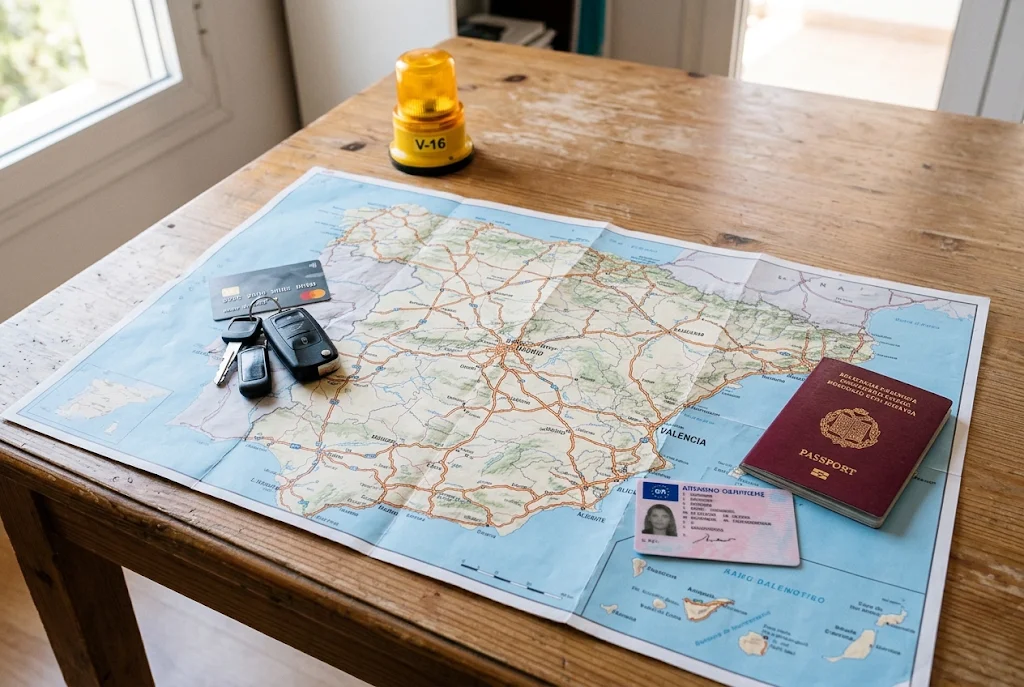
Car hire in Valencia is straightforward, provided you have the right documents and know a few rules that might differ from home. An expired licence or a forgotten payment card could leave you stranded at the rental desk, while traffic fines in Spain often have to be paid on the spot.
This guide covers everything you need to know before and during your rental: required documents, payment cards, rental car deposit rules, insurance, and essential traffic regulations across Spain. You can compare all available deals on our Valencia car rental page.
Documents You Need
| Document | Requirements |
|---|---|
| Driving licence | Valid, usually held for at least 1 year (longer for certain vehicle categories). EU and Greek licences are accepted without an International Driving Permit. |
| ID card or passport | Must be in the name of the main driver. |
| International Driving Permit (IDP) | Required only for certain non-EU licences. Always check the rental terms of your offer. |
| Payment card | A physical card in the main driver’s name, used to hold the rental deposit. |
| Booking voucher | Either printed or in digital format on your phone. |
Driver Age Requirements
Most car hire companies require a minimum age of 21, and drivers under 25 typically incur a daily young driver surcharge. For larger or premium vehicle classes, age limits are often higher. Certain suppliers also apply an upper age limit. The exact terms are clearly displayed in each offer’s conditions.
Cards, Security Deposits, and Debit Card Car Hire
When picking up the vehicle, the supplier will pre-authorise an amount on your card as a security deposit. This hold is released once you return the car undamaged. While most rental companies in Spain prefer a credit card, some deals accept debit cards or require no deposit at all. You can filter for these on our car rental in Valencia without a credit card page.
Keep the following in mind:
- The card must be in the main driver’s name.
- Prepaid cards and virtual cards are generally not accepted for the security deposit.
- If you opt for debit card car hire, ensure your available balance comfortably covers the pre-authorisation hold.
Insurance and Excess
Most rental rates include basic cover with an excess—the maximum out-of-pocket amount you are liable for in case of damage. Full coverage reduces this excess to zero or a minimal sum. Watch out for two important details:
- Exclusions: tyres, glass, undercarriage, and lost keys are frequently excluded from standard basic cover.
- Double insurance: if you have already purchased full coverage online through your booking, the counter staff may still offer you their own package. You are under no obligation to buy it, but bear in mind that the standard deposit hold will still apply on your card.
Fuel Policies
Whenever possible, choose a “full-to-full” policy: you collect the car with a full tank and return it full, paying only for the fuel you actually use. At Spanish petrol stations, unleaded petrol is labelled as gasolina (usually 95 or 98 octane) and diesel as gasóleo or diésel. Always check what fuel the engine takes before filling up, as misfuelling is not covered by insurance. Many stations operate as self-service, requiring payment either before or after pumping.
Key Driving Rules in Spain
Speed Limits
- Motorways (autopistas/autovías): 120 km/h.
- Secondary/rural roads: 90 km/h.
- Urban areas: 50 km/h, reduced to 30 km/h on single-lane roads in each direction, and 20 km/h on shared streets where the pavement and road are at the same level.
Fixed-point and average-speed cameras are widely deployed. Speeding fines are forwarded to the rental supplier, who will charge your card an additional administrative fee on top of the fine itself.
Drink Driving Limits
The standard legal limit is 0.5 g/l of blood alcohol (0.25 mg/l in breath), dropping to 0.3 g/l for drivers who have held their licence for less than 2 years. Police checkpoints are frequent, especially on weekends. The safest approach is strictly zero alcohol when driving.
V-16 Emergency Beacon and High-Vis Vest
From 2026, Spain has adopted the V-16 beacon—a flashing yellow hazard light placed on the vehicle roof—to replace traditional warning triangles when a car is immobilised. At pick-up, verify that your car has both the V-16 light and a reflective high-vis vest on board. Always slip on the vest before exiting the vehicle on the roadside.
Mobile Phones and Other Violations
- Handling a mobile phone while driving is strictly illegal, even when stationary at red lights.
- Seatbelts are mandatory for every passenger, and children must be seated in an approved child car seat suited to their height.
- On roundabouts, traffic already inside the circle has priority. Always move into the outside lane before taking your exit.
On-the-Spot Fines for Non-Residents
Traffic police can require drivers without permanent residency in Spain to pay traffic fines on the spot. A discount is usually offered for immediate payment. The best way to avoid hassle is to follow road signs and posted speed limits closely.
Tolls and Low Emission Zones
Most motorways around Valencia are toll-free, though some stretches remain tolled. Ask at the rental desk whether your vehicle is equipped with an electronic toll transponder. Several Spanish cities, including Valencia, enforce Low Emission Zones (ZBE). You can learn more about local restrictions in our guide to driving and parking in Valencia.
Cross-Border Travel and Ferry Trips to the Balearics
Taking your rental car onto a ferry—such as to Mallorca or Ibiza—is generally prohibited or requires express prior approval. Similarly, cross-border travel into France or Portugal often involves an extra fee. If you plan to leave mainland Spain or cross borders, check the rental terms carefully before booking. For regional day-trip inspiration, take a look at our road trips from Valencia guide.
Vehicle Inspection at Pick-up and Drop-off
- Take photos or video of the entire vehicle from every angle, including wheels, rims, windows, and the fuel gauge display.
- Every existing scratch or dent must be noted on the rental checkout sheet before you drive away, no matter how minor.
- At drop-off, ask an agent to inspect the car in your presence, and keep the signed return receipt along with your final fuel receipt.
Frequently Asked Questions
Do I need an International Driving Permit in Valencia?
No, not if you hold a valid EU or Greek driving licence. Drivers holding licences issued outside the EU may need an IDP depending on the issuing country.
Can I hire a car in Valencia with a debit card?
Yes, provided the rental deal explicitly states that debit cards are accepted. You can easily find these by using the “No credit card required” filter in your search.
Does the rental car come with warning triangles or a V-16 beacon?
From 2026, Spain uses the V-16 light beacon to mark immobilised vehicles. At pick-up, verify that the beacon and reflective vest are inside the car.
Are rental cars in Spain mostly manual?
Yes, the vast majority of rental fleets are manual transmission. If you prefer an automatic, book well in advance, as availability is limited and prices are usually higher.
Once your documents are in order, find the best deal for your trip: compare all rental companies for car hire in Valencia, and read our dedicated guide on picking up a rental car at Valencia Airport.
NEXT STEP
Car rental prices in Valencia
More guides · Valencia